For churches · Free options
Free church website builders: what free really means
Free plans and trials · checked November 2026
A church can put a website online for nothing. The honest questions are what the free version leaves out, how long it stays free, and who does the work. Here is each free option, what it really includes, and when to stop using it.
What it looks like
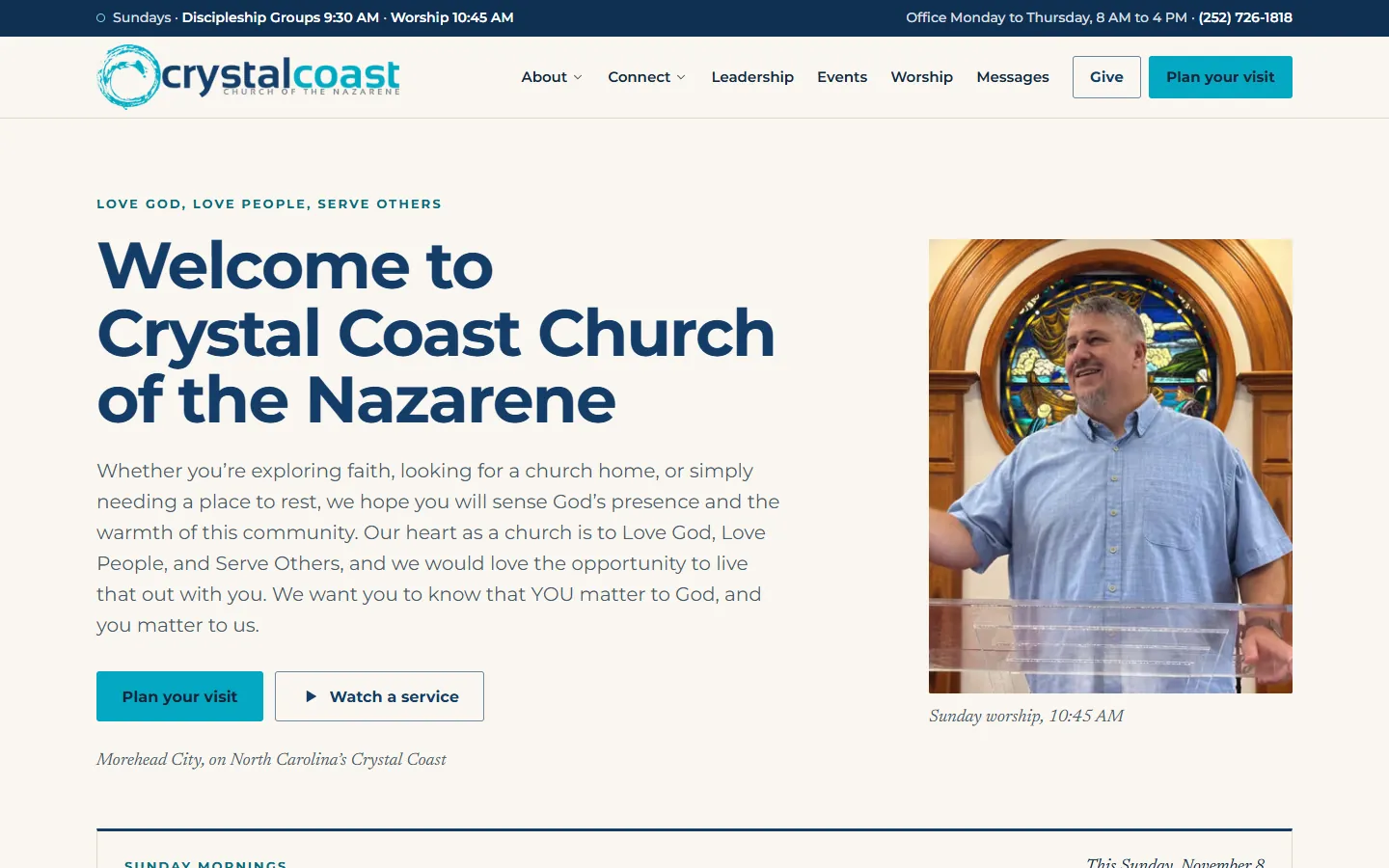
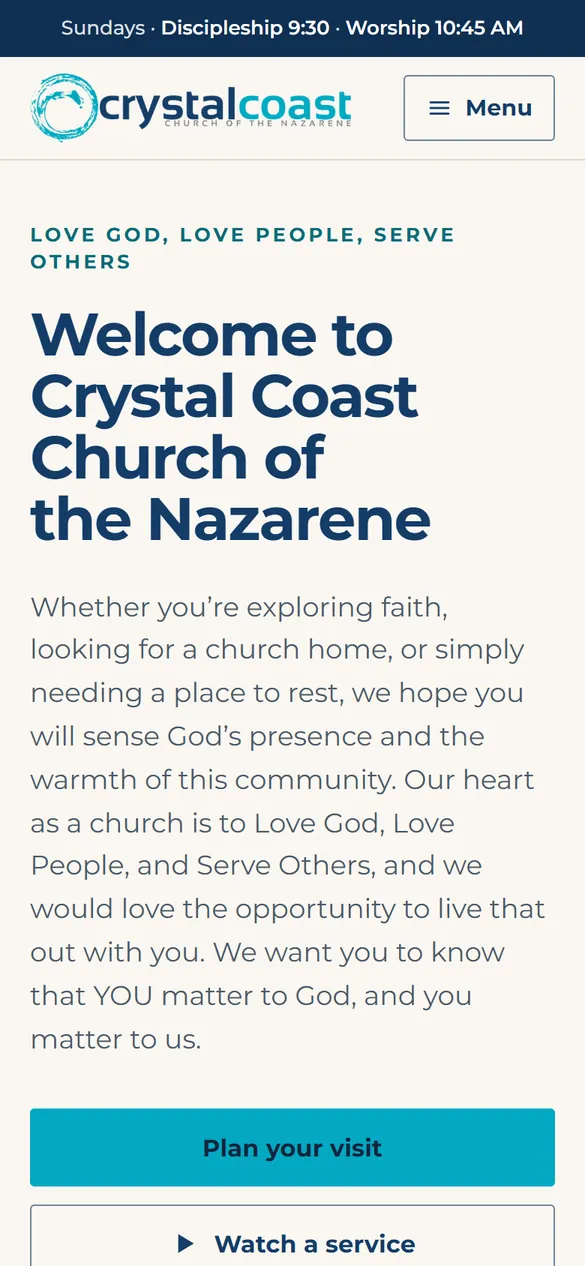
A finished church site, built and kept current for you
$90 a month for as long as you stay (regular $120). No setup fee. Nothing to pay until your site is live.
Custom design, hosting and every update by email. No contract, and a real person replies within one business day.
The options
Free plans, free trials and free software
Wix: a real free plan
Wix lists a $0 plan with hosting and templates (checked November 10, 2026). A paid plan, from $17 a month billed annually, is what connects your own domain and removes the Wix branding.
GoDaddy: a free tier
GoDaddy's website builder has a free tier, with paid plans advertised from about $9.99 a month at introductory rates. Renewals run higher.
WordPress: free software, paid hosting
The software is free and open source. Hosting is about $5 to $30 a month at introductory rates (observed 2026-08-19), and someone has to keep it updated.
Squarespace: a trial, not a free plan
14 days free, then from $19 a month billed annually (checked November 10, 2026).
Church builders: trials only
The church-specific builders we checked offer trials, not free plans: Tithe.ly Sites 30 days (checked October 2026) and The Church Co 14 days. After that, from $19 and $29 a month.
A Facebook page
Free and familiar, and worth having. It is not a website: a guest searching for a church nearby is looking for service times and an address on a page Google can read.
The catch
What a free church website leaves out
Your own domain
Free plans put the site on the builder's address. yourchurch.org is what goes on the sign, the bulletin and the Google listing, and it is the one thing that moves with you if you change builders.
A clean page
Free tiers carry the builder's branding or ads. On a church site that reads as temporary.
Church features
General builders have no giving, sermon library or event registration built in. Those are added with separate tools, each with its own login.
Someone to do the work
Free covers the tool. Our 2026 study of 1,734 small-church websites found 72.8% had been updated within the year, and among the sites whose platform cost is visible, those at $12 a month or less (144 sites) were current 72.9% of the time against 88.1% for sites over $20 a month (101 sites). Correlation, not causation, but the cheapest sites are the ones most often left alone.
When it fits
When free is the right call, and when to move on
Free is the right call for a church plant before launch, for a congregation with no budget line and one willing volunteer, and as a placeholder while a real site is being built. Put service times, the address and a contact on it and it is doing its job.
Move on when the church has a sign and a Google listing, because both should point at a domain you own. The first paid step is small: about $17 to $19 a month on a general builder, or $19 on a church-specific one. If nobody wants to run it, Church Digital builds, hosts and updates the site for $120 a month flat, no setup fee, no contract, and the founding rate makes it $90 a month for as long as you stay.
Common questions
Questions churches ask
- Is there a completely free church website builder?
- Yes. Wix has a $0 plan and GoDaddy has a free tier, and WordPress is free software if someone provides hosting. Each leaves out your own domain or adds the builder's branding, and all of the work falls to a volunteer.
- What is the best free website builder for a church?
- For a placeholder, the one your volunteer already knows how to use. Wix is the simplest free plan to start on. Buy the domain separately in a church-owned account from day one, so the site can move to a paid plan or another builder without losing its address.
- Can a church use a free website with its own domain name?
- Generally not on a builder's free plan. On Wix a paid plan is what connects a custom domain. The low-cost route to your own domain is an entry plan at about $17 to $19 a month billed annually.
- Is free web hosting safe for a church website?
- Hosting from a major builder is reliable whether the plan is free or paid. The risk is ownership, not uptime: a site on a member's donated server, or under one volunteer's personal login, can disappear when that person moves on. Keep the domain and the account in the church's name.
- How much does it cost to move from a free site to a paid one?
- On the same builder it is an upgrade, with nothing to rebuild. Moving to a different builder means copying the pages across, which takes a volunteer a few hours for a small site. Built for you, Church Digital charges $120 a month flat with no setup fee.
Outgrown the free site
Send what you have and see what the next version could look like
We record a free four-minute review of your current site, or show you a homepage concept built from your own words and photos. No pitch, no call required.
Go deeper