For churches · Getting found
Church SEO: how a small church gets found on Google
Figures from 1,931 church websites · 2026
Church SEO is the work of showing up when someone nearby searches "churches near me" or types your church's name. For a small church it is not blogging or buying links. It is a correct Google listing, a homepage Google can read, and a few pages that answer what a first-time guest is asking. Here is the order to do it in.
What it looks like
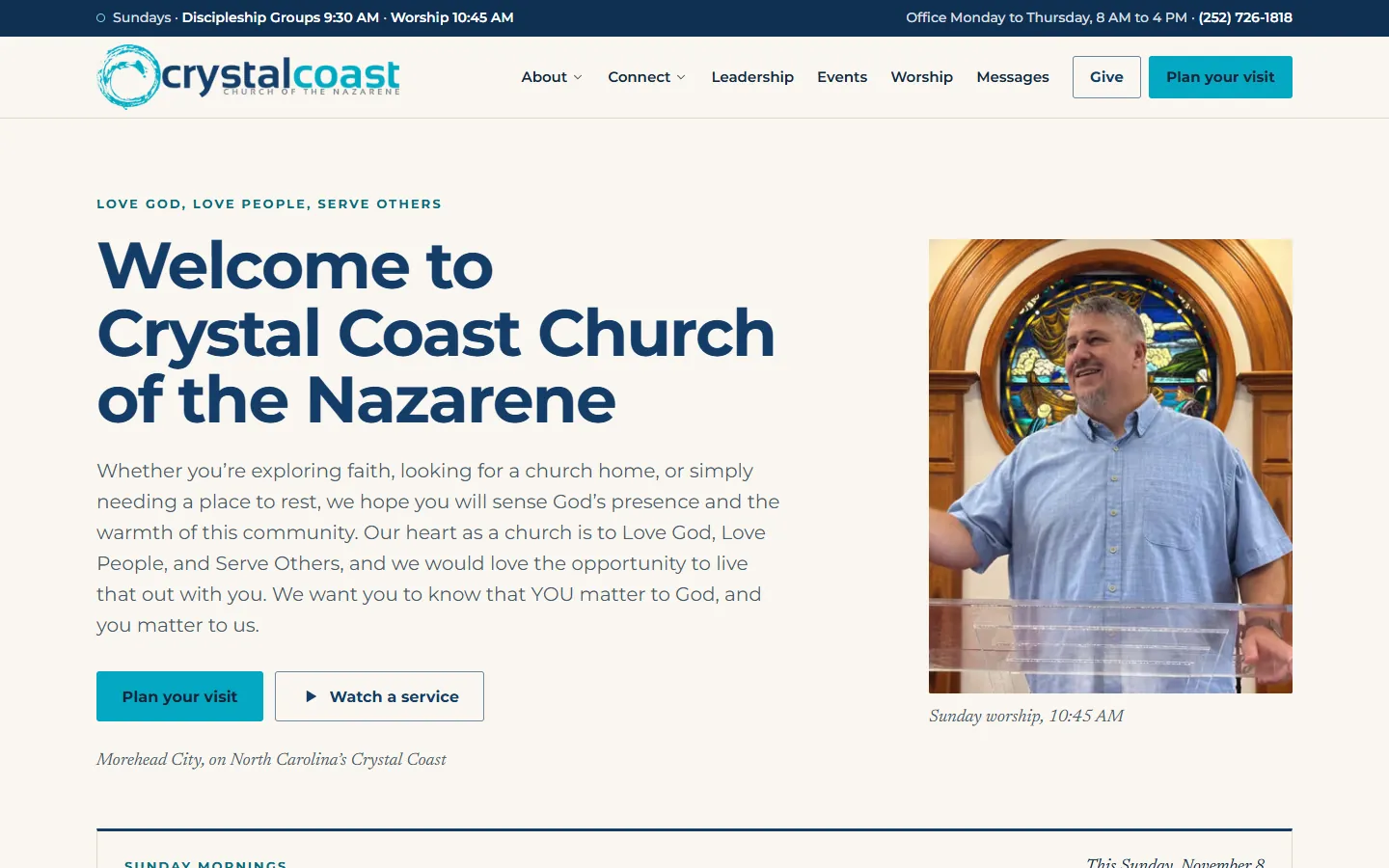
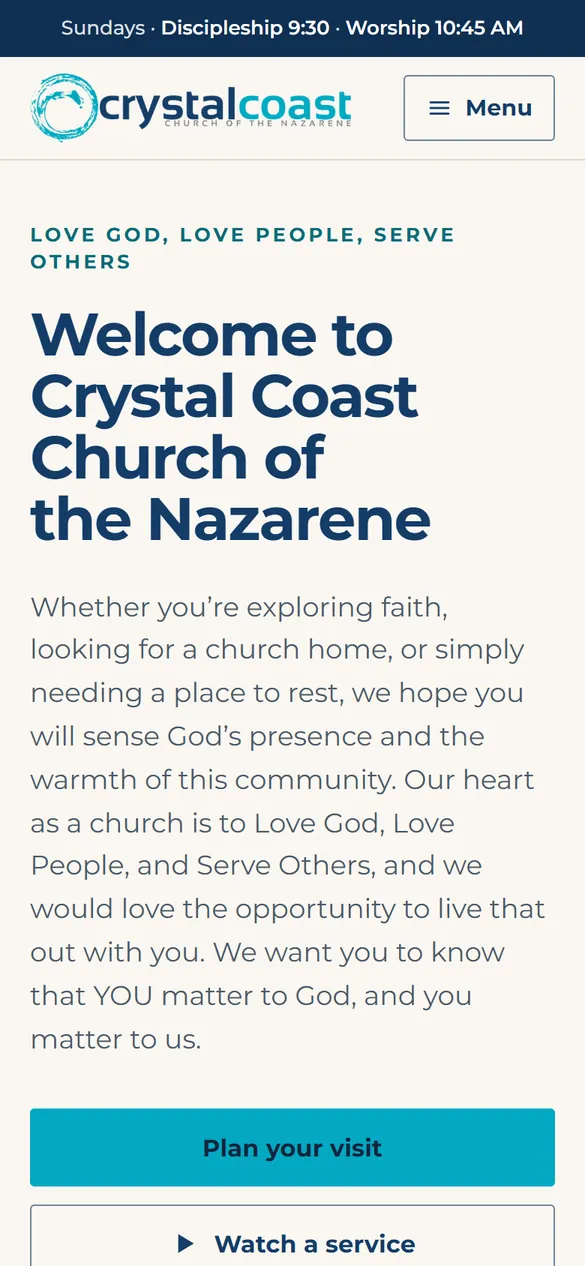
A finished church site, built and kept current for you
$90 a month for as long as you stay (regular $120). No setup fee. Nothing to pay until your site is live.
Custom design, hosting and every update by email. No contract, and a real person replies within one business day.
Start here
Your Google Business Profile comes first
When someone searches "church near me," Google shows a map and a short list of churches above the websites. Those listings come from Google Business Profile, which is free. A complete and accurate profile is the first thing to get right, and a wrong one works against even a good website.
Claim the profile
Search your church name in Google Maps. If nobody at the church manages the listing, claim it with a church-owned Google account.
Pick the most specific category
Choose the church category that fits best, such as "Baptist church" or "Non-denominational church," over a general one.
Match the website exactly
Name, address, phone and service times should read the same on the profile and on the homepage.
Add real photos
The building from the street, the entrance and a Sunday service. Guests use them to recognize the place.
Ask members for honest reviews
A short review helps a guest decide, and Google shows the rating beside your name.
The homepage
Six homepage basics, and how many churches have them
We checked the homepages of 1,931 church websites in our 2026 study (full method at /research). These are the basics Google and shared links read first.
97.6%
had a page title
It is the blue link in Google, so it should say the church name and the city.
62.4%
had a meta description
It is the two lines under the link. Say who you are, where you are and when you meet.
39.9%
had exactly one main heading
A single clear heading tells Google what the page is about.
47.3%
had a share image
It is the picture that appears when a member texts or posts your link.
81.9%
had a favicon
It is the small icon beside your name in a browser tab and in Google results.
34%
had a visit counter of any kind
Without analytics you cannot tell whether any of this is working.
The six-item church SEO checklist, with the fix on each platform →
The pages
The pages that bring first-time guests
Service times and address as text
Our 2026 study of 1,734 small-church websites found findable service times on 83.9% of sites. Times that sit inside an image are hard for Google to read.
A plan-a-visit page
Where to park, what to wear, how long the service runs and what happens with kids. It answers the questions people search before a first visit.
A page for each main ministry
Kids, students, small groups. Each one matches a search a nearby family makes.
Sermons with titles and text
A title, a passage and a short summary for each message give Google words to read. A bare video embed gives it very little.
A site that works on a phone
93.4% of small-church sites in the study were set up for mobile. That is not the same as fast, so test yours on a phone using cell data.
What to skip
What a small church can skip
Paying for backlinks or directory blasts
They rarely help a local church. The links worth having come from your denomination, your city and partner ministries.
Repeating the city name everywhere
Say where you are in the title, near the top of the homepage and in the footer address. Repeating it more reads badly and does not help.
A blog nobody will keep up
Posts that stopped months ago make a guest wonder whether the rest of the site is current. Start one only when someone will keep it going.
Chasing the top spot for the word "church"
The searches that matter are your own name and "church" plus your town. Those are winnable.
Who does it
If nobody on staff wants this job
The Google listing takes an afternoon and the homepage basics are a one-time job on any builder, so a volunteer can do all of it.
It also comes with the site we build. Each Church Digital site is built with a page title and description, one main heading, service times as text and a sitemap, for $120 a month flat, no setup fee, no contract, and the founding rate makes it $90 a month for as long as you stay. The Google Business Profile stays in the church's own account.
Common questions
Questions churches ask
- What is church SEO?
- Church SEO is helping people find your church through Google. For a small church that means an accurate Google Business Profile, a homepage with a clear title, description and heading, and pages that answer what a first-time guest wants to know.
- How long does church SEO take to work?
- Changes to the website usually take a few weeks to show in search, because Google has to revisit the pages. Searches for your own church name tend to improve first. Searches such as "church near me" depend mostly on the Google Business Profile and how close the searcher is.
- Does a small church need to pay for SEO?
- Usually not. The Google listing is free, and the homepage basics are a one-time job on any builder. Paying makes sense when nobody on the team will do that work, or when the site itself is the problem.
- Does a church need a blog for SEO?
- Not to start, in our view. The Google listing and the homepage basics come first. A blog helps only when someone will keep it up.
- Do you do SEO for churches?
- We do not sell SEO retainers. The search basics on this page are built into every site we make, and the site is $120 a month flat with no setup fee and no contract, or $90 a month at the founding rate.
More comparisons and guides
- Clover Sites alternative
- Faithlife Sites alternative
- Sharefaith alternative
- Church Plant Media alternative
- Tithe.ly Sites alternative
- Subsplash alternative
- The Church Co alternative
- Church Digital vs ReachRight
- Church Digital vs Ministry Designs
- Church Digital vs Nucleus
- Church Digital vs OurChurch.com
- Church Digital vs Subsplash
- Church Digital vs The Church Co
- GoDaddy for church websites
- Church website companies compared
- When the website volunteer leaves
- Baptist church websites
- Google Ad Grants for churches
- Church website cost in 2026
- Church website maintenance
- Pushpay alternatives
See how Google reads your site
Send your site and get a four-minute review
We walk through your homepage the way a first-time guest sees it: the title, the service times, the phone layout and the give link. No pitch, no call required.
Go deeper